



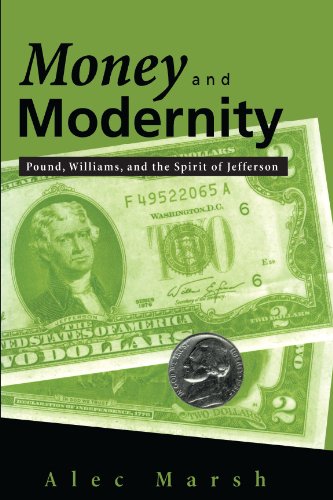
Money and Modernity: Pound, Williams, and the Spirit of Jefferson

 4.3 (47 items)
 Limited Time Sale
US$15.67 cheaper than the new price!!
Free cash-on-delivery fees for purchases over $99
Product details
| Management number | 233425621 | Release Date | 2026/06/27 | List Price | US$10.44 | Model Number | 233425621 | ||
|---|---|---|---|---|---|---|---|---|---|
| Category | |||||||||
Marsh locates Pound and Williams firmly in the Jeffersonian tradition and examines their epic poems as manifestations of a Jeffersonian ideology in modernist terms. The modernist poets William Carlos Williams and Ezra Pound were latter-day Jeffersonians whose politics and poetry were strongly marked by the populism of the late 19th century. They were sharply aware of the social contradictions of modernization and were committed to a highly politicized, often polemical poetry that criticized finance capitalism and its institutions--notably banks--in the strongest terms. Providing a history of the aesthetics of Jeffersonianism and its collision with modernism in the works of Pound and Williams, Alec Marsh traces "the money question" from the republican period through the 1940s. Marsh can thus read two modernist epics--Pound's Cantos and Williams's Paterson--as the poets hoped they would be read, as attempts to break the hold of "false" financial values on the American imagination. Marsh argues that Pound's and Williams's similar Jeffersonian outlooks were the direct result of the political battles of the 1890s concerning the meaning of money. Although Pound's interest in money and economics is well known, few people are aware that both poets were active in the Social Credit monetary-reform movement of the 1930s and 1940s, a movement shown by Marsh to have direct links to Jeffersonianism via American populism. Ultimately, the two poets took divergent paths, with Pound swerving toward Italian fascism (as exemplified in his Jefferson and/or Mussolini) and Williams becoming deeply influenced by the American pragmatism of John Dewey. Thus, Marsh concludes, Pound embraced the fascist version of state-capitalism whereas his old friend proclaimed a pragmatic openness to the new selves engendered by corporate capitalism. Money and Modernity exemplifies the best of recent literary criticism in its incorporation of American studies and cultural studies approaches to bring new insight to modern masterworks. Read more
| ASIN | B006THRQK0 |
|---|---|
| XRay | Not Enabled |
| ISBN13 | 978-0817386023 |
| Edition | First |
| Language | English |
| File size | 1.1 MB |
| Page Flip | Enabled |
| Publisher | University Alabama Press |
| Word Wise | Enabled |
| Print length | 310 pages |
| Accessibility | Learn more |
| Screen Reader | Supported |
| Publication date | September 23, 2011 |
| Enhanced typesetting | Enabled |
Bestseller ranking
Deer Park Water

Customers who viewed this product also viewed
Poetry




Correction of product information
If you notice any omissions or errors in the product information on this page, please use the correction request form below.
Correction Request Form